AboutApril 13th, 2026
Let the machines do the work.
HAL Defiant computer in "2001: A Space Odyssey", used here to refer to artificial intelligence.
This place in which we live is so stunningly beautiful and yet cameras are powerless compared to our eyes.
There's a phenomenon called "perspective distortion" where the mountain in the distance sometimes looks tiny and sometimes looks massive depending on your current surroundings. It's as if your brain has a subconscious telephoto lens that it uses without your permission.
In 1964 my father brought a mechanical calculator home from his office that was no longer needed, a case of old technology being replaced by new. To multiply 9 by 4 you pressed the number 4 and exercised the handle or plunger or whatever that thing in the lower right corner was called, nine times. The result showed up in the window. The highly educated, savvy secretary could save time by entering 9 and exercising the plunger four times. I played with that thing for hours. I don't remember any of the other operations and have no interest in hal informing me.
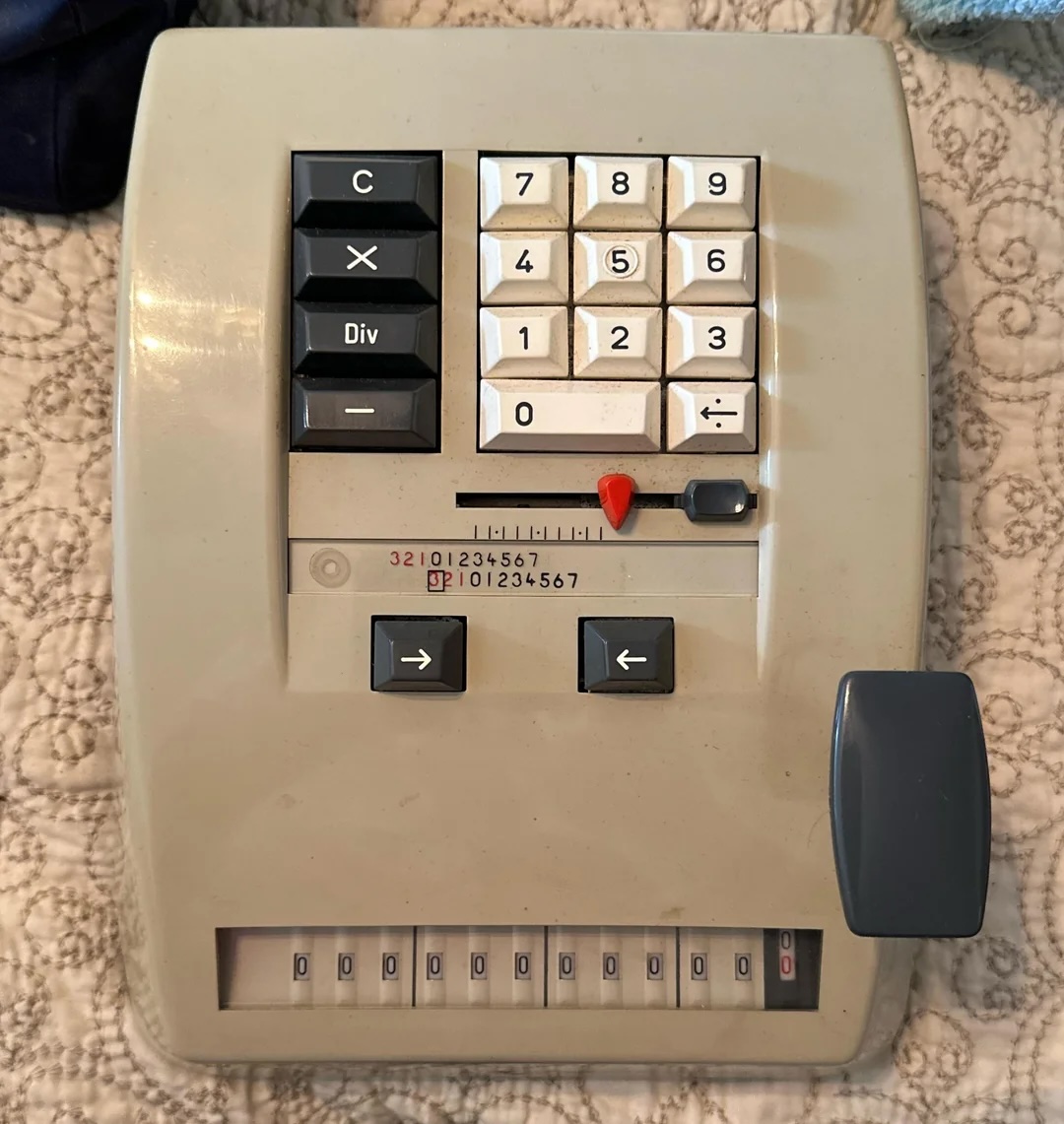
Bohn Contex Model 10 Mechanical Calculator
In 1972, at age seventeen, while sequestered in the high school's janitor's closet, I hit the Return key on a IBM 2741 that was connected to a Bell 103 acoustic modem that caused a request for login credentials from a DEC System 10 mainframe located 2.17 miles away to be printed on paper. So began an enjoyable career during which I provided reams of data that went unread by mismanagers who constructed towers of printouts against their office walls, a form of art to me. The various computers I worked on could perform millions of operations in a second, saving many more millions of plunger depressions.
Also in 1972, I bought an HP-35C calculator, the greatest machine of any kind built by humans up to that point. (In 2004 the calculator was surpassed in greatness by an 8'6" fiberglass windsurf board made by Cascade. That, in turn, was surpassed by the Toto Washlet in 2010 which remains unsurpassed). The calculator wasn't as fast as the computers I was working on but it fit in my pocket, way more convenient than toting around the Bohn Contex.

HP-35C Calculator
In 1982 I bought a Canon AE-1 Program single-lens reflex (SLR) camera along with several lenses that helped distort reality, bringing the mountain in the distance right up to my face. A roll of 35mm film cost about $3.50 for twenty exposures. I'd try to plan it so that I'd shoot the last exposure at the end of the adventure I was on. I'd take the film to the photo store and get my prints or slides a few days later for another five to ten dollars. I'd have the really good ones, so I thought, enlarged and mounted on medium density fiberboard. The hundreds of others sat in a shoe box until I scanned them earlier this year. Now, they're back in the shoe box but the images sit on this solid-state drive, ready to be manipulated.
I bought my first digital camera, a Sony, in 2000. The images weren't very large by today's standards but gratification was instant and "film" and processing were free. Here was one of the baby steps that has led to the destruction of society. I'll save that for a later journal entry.
IN 1987, Thomas Knoll, a PhD student at the University of Michigan, created a program called "Display" to show grayscale images from scanned slides on his Macintosh Plus. By 1990 Adobe got its mits on it and marketed it as PhotoShop 1.0, laying the path toward becoming an industry standard.
In 2008, I changed jobs, from idle, early retirement to managing an e-commerce site for a local retailer. I applied nearly a dozen layers of software to present their inventory online. The job required that, in addition to arranging product tables and prices, I learn Photoshop to modify reality. I "corrected" images so the company could lie to their customers.
In 2021 I bought an iPad and an Apple Pencil intending to teach myself to digitally paint. It took about a week for me to realize that I had no talent for painting anything from scratch so I imported images to Procreate to use as a base and then paint over those, sort of like tracing. That was better, but still useless. So I naturally went in search of a software solution.
After testing various applications, I settled on one called BeCasso. BeCasso applies filters over my original image making it look like something else: a pencil drawing, an oil painting, watercolor, cartoon and others. There are about 100 different filters. Each filter has a dozen or so tools that can be applied, such as brush stroke width, black point, smudge and saturation, that modify the chosen filter. Then there's another panel of tools that allow cropping, erasing, background paper, vignettes and so on. By the time I've explored the various combinations for an image I end up with something that preserves the original but presents it in a whole new light.
Here's a short video by the creators of Becasso.
An artist creating a painting isn't trying to be efficient. She is immersed in a different world where time has no meaning. Distractions from the chaotic world are shelved for another time. Such a lucky person has no use for BeCasso. But as a slovenly, talentless software engineer I can use a digital camera, this Mac mini M4 and BeCasso to avoid exercising the Bohn Contex plunger an infinite number of times.
So, I present my images here because they are useless hiding in a box or sitting hidden on a drive. If only one person enjoys just one, then something good has come of it.
From that early Bohn Context calculator on through the HP35C, to room size computers that got faster and faster as they got smaller and smaller, to personal computers, laptops and now phones, each progression in computing made things faster and easier. Until now. The industry is pushing HAL hard, whether HAL gets it right or not. They, the industry, admit that it's not perfect and that it makes errors. HAL even fesses up when it makes a mistake. This is where my progression in technology stops.
Imagine aerospace engineers, elevator designers, automobile companies or weapons designers using hardware and software that rendered correct solutions only part of the time.
Close enough!